03PPC marketing
A PPC marketing agency that fixes the tracking first.
PPC marketing can put you in front of buyers today, and it can burn through a budget just as quickly. We run Google, Microsoft and paid social campaigns built around what a customer is worth to you, measured properly and adjusted every week.
APPC marketing
What our PPC marketing services include
- 01
Account audit
A line-by-line review of your current account: wasted search terms, missing negatives, broken tracking and campaigns that overlap.
- 02
Google Ads and Microsoft Ads
Keyword research, campaign structure, ad copy and bidding on search, with budgets split so money can follow what works.
- 03
Shopping and Performance Max
Product feed cleanup, asset groups and audience signals for online stores and lead-gen accounts that are ready to grow.
- 04
Paid social
Meta, LinkedIn and TikTok campaigns with creative made for each placement, instead of one banner resized five times.
- 05
Conversion tracking
GA4, Google Tag Manager and enhanced conversions set up so the platforms optimize toward real leads and sales, not page views.
- 06
Landing pages
A focused page for each campaign, designed and built in-house, quick on a phone and tested against alternatives.
BProcess
How we run a PPC account
- 01
Measure
Tracking gets fixed before any budget moves. Every form, call and sale should be counted once, with a value where possible.
- 02
Build
Campaigns structured around your margins and target cost per lead, with budgets and limits you approve.
- 03
Optimize
Weekly search-term reviews, new negative keywords, bid and budget changes, plus ad and landing page tests.
- 04
Report
Spend, conversions, cost per result and revenue in one dashboard, and a monthly call about what changes next.
§In depth
What is PPC in marketing?
PPC stands for pay-per-click. You bid for your ad to appear, and you pay only when someone clicks it. On Google the ad shows above or below the normal results for searches you choose; on Meta, LinkedIn or TikTok it appears in the feeds of people who match your targeting. PPC marketing is the work of choosing those searches and audiences, writing the ads, setting bids and making sure the clicks turn into customers.
Click prices come from an auction. Google weighs your bid against the ad's expected click-through rate, its relevance and the landing page experience. So a tidy campaign with a good page can win placements while paying less than a rival with a bigger bid. It's one of the few corners of marketing where careful work shows up directly on the invoice.
What a PPC marketing agency does day to day
Most of the job is unglamorous. We read search-term reports and block the searches that waste money ("free", "jobs", "DIY", "course"). We move budget away from campaigns that cost too much per lead and toward ones that don't. We write new ads and retire the losers. And we check that conversion tracking still fires after every site change, because one broken tag can quietly steer automated bidding in the wrong direction for weeks.
Ads are only half the system. The other half is the page people land on. Because we're also a web design company, we build a dedicated landing page for each campaign instead of sending paid clicks to your home page: one message, one action, fast on a phone.
A sample account structure
Here's a simplified, hypothetical example: a roofing contractor working across Dallas–Fort Worth. Each campaign gets its own budget and goal, so money can shift toward whatever is producing jobs.
| Campaign | What it targets | Why it stands alone |
|---|---|---|
| Brand | Searches for the company name | Cheap, converts well and keeps competitors off the name |
| Roof repair | "roof leak repair", "storm damage roof repair" | Urgent intent; needs call-focused ads and its own budget |
| Roof replacement | "roof replacement cost", "new roof" | Bigger jobs, longer decisions, a different landing page |
| Remarketing | Visitors who didn't get in touch | A short follow-up with a clear reason to come back |
A shared negative keyword list runs across all of them. Location targeting covers only the counties the business really serves, and bids by area are adjusted once results show where jobs come from.
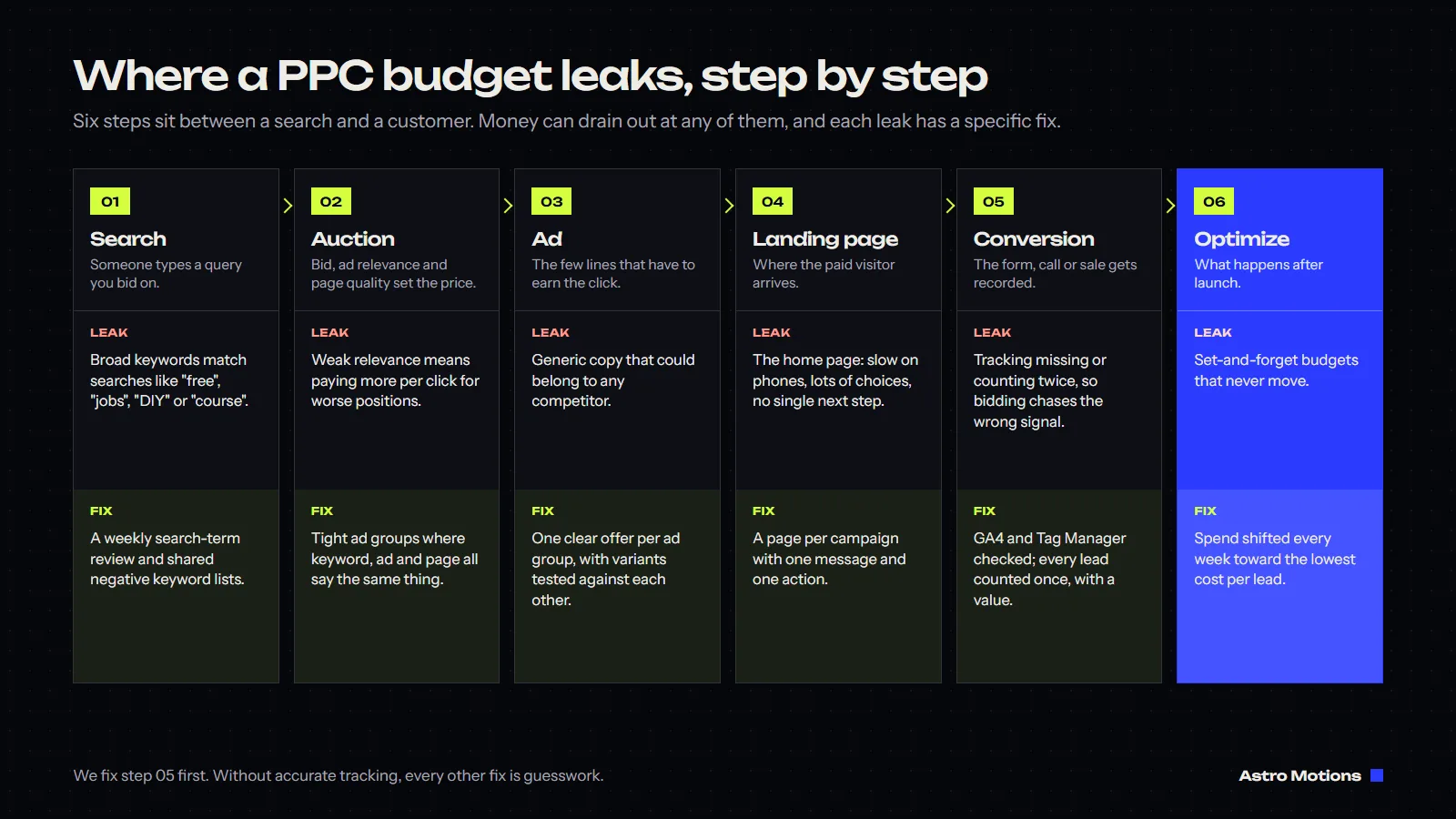
Keywords, match types and negatives
Google offers three match types, and the choice decides how loosely your keyword is read. Exact match shows your ad for searches with the same meaning as the keyword. Phrase match allows extra words around it as long as the meaning holds. Broad match lets Google show the ad for anything it judges related, which can find new demand but can also wander a long way from what you sell.
We usually start new accounts on exact and phrase match, so the first few weeks of data are clean. Broad match comes in later, paired with smart bidding, once the account has enough conversions for the automation to learn from. Negative keywords do the rest. A plumber probably wants to exclude "plumbing course" and "plumber salary"; a law firm might exclude "free legal advice" and "paralegal jobs". The list grows every week from real search terms rather than guesswork.
Performance Max, Shopping and automation
Google's automated campaign types, Performance Max above all, can work well. They also hide a lot of what they do, and they optimize toward whatever you count as a conversion. Feed them bad data and they'll find more of the wrong thing, very efficiently. So automation comes after tracking is reliable and after there's a reasonable history of conversions, not before.
For online stores, the product feed is half the job. Clear titles that match how people search, accurate prices and stock, good images and sensible product groupings make a bigger difference to Shopping results than most bid tweaks. We clean the feed first, then let the automation loose on it.
Landing pages that convert paid traffic
A good landing page repeats the promise of the ad in its headline, so the visitor knows they're in the right place. It explains the offer in a few short sections, shows proof such as reviews or examples, answers the two or three objections people usually have, and asks for one action. It loads fast on a phone. It doesn't carry the full site menu, because every extra link is an exit.
We build these pages ourselves and test them. Sometimes the test is a headline; sometimes it's a shorter form or a different order of sections. Small changes on a page that receives paid traffic can matter more than any change inside the ad account, because they improve every click you've already paid for.
The numbers that matter in PPC
| Metric | What it tells you | How we use it |
|---|---|---|
| Cost per click (CPC) | What each visit costs | Context only; cheap clicks can be worthless |
| Click-through rate (CTR) | How often people who see the ad click it | A check on ad relevance and copy |
| Conversion rate | Share of clicks that become leads or sales | Mostly a landing page and offer signal |
| Cost per acquisition (CPA) | What each lead or sale costs | The main target for lead-gen accounts |
| Return on ad spend (ROAS) | Revenue per dollar of spend | The main target for online stores |
The right target for CPA or ROAS comes from your margins and what a customer is worth over time, not from an industry average. We work that out with you before setting bids.
Why PPC campaigns usually fail
When we audit an account that isn't working, the causes are rarely exotic. Tracking that counts page views or duplicate form fills as conversions. One campaign covering every service, so budget can't follow the profitable ones. Broad keywords with no negatives. Ads sending every click to the home page. Bids set once and never revisited. And sometimes a simpler problem: the offer itself isn't competitive, which no amount of account work can fix. We'll tell you if that's what we find.
Your first 90 days
In the first couple of weeks we audit the account, fix tracking and agree targets. By the end of the first month the restructured campaigns and first landing pages are live. Months two and three are for learning and tightening: cutting waste, testing ads and pages, shifting budget toward what converts and, if the data supports it, adding new campaigns or platforms. At the 90-day review you'll know what each channel costs per result and where the next dollar should go.
PPC marketing services across search and social
Search ads catch people who already know what they need. Paid social reaches them earlier, before they've started looking. Running both lets us compare cost per lead across channels and move money to whichever is cheaper. Posts that are already doing well organically can be promoted quickly too, particularly when our team also runs your social media marketing services.
Platform choice follows the buyer. Google and Microsoft for people actively searching. LinkedIn when you sell to a particular job title. Meta and TikTok for consumer products that look good in a feed. YouTube when the product needs a demo.
PPC and SEO work better together
Paid search sends traffic the day a campaign launches; organic rankings take months. That makes PPC a handy testing ground. Within a few weeks you can see which keywords bring leads, then put long-term effort into the ones that convert. Our organic SEO services use exactly that data. As rankings grow you can often lower bids on terms you already hold organically, though brand campaigns are usually worth keeping.
How to compare PPC marketing agencies
A handful of questions sorts most PPC marketing agencies quickly. Who owns the ad accounts? (It should be you.) Is the management fee separate from ad spend, or is a markup hidden in the media bill? How is a conversion defined, and can they show you the tracking? Who actually works on the account each week? A PPC marketing company that goes vague on any of these deserves a second look.
Our answers don't change: the accounts are in your name, our fee is separate and agreed up front, and you can see the tracking setup and the dashboard whenever you like. That transparency is the same across everything we do as a digital marketing agency.
PPC management for businesses across the US
We manage campaigns remotely for businesses all over the United States. A home services firm in Houston, a clinic in Los Angeles and a software company in New York need very different budgets and bids, but the method holds: accurate tracking, tight targeting and a landing page that does its job. Location targeting is set to the areas you serve, down to ZIP codes when that helps. If you searched "PPC agency near me", what you're probably after is a team that reports clearly and answers fast, and that part doesn't depend on geography.
What sets the cost of PPC management
You pay two separate things: the ad spend, billed to you directly by Google, Microsoft or Meta, and our management fee. The fee depends on how many platforms and campaigns we run, whether product feeds are involved, how many landing pages and ad creatives are needed and how complicated the tracking is. Offline sales and CRM imports, for instance, take more setup than a single contact form. We agree on the fee before we start, so tell us what you spend now and we'll say where we'd begin.
?FAQ
PPC marketing questions
What is PPC in marketing?
PPC, or pay-per-click, is online advertising where you pay only when someone clicks your ad. The main platforms are Google Ads, Microsoft Ads and paid social on Meta, LinkedIn and TikTok.
What does a PPC marketing agency do?
It plans, builds and manages your paid campaigns: keyword and audience research, ad copy, bidding, budgets, conversion tracking and landing pages. A good one also reports clearly on what each dollar of spend produced.
How much should I spend on PPC?
Enough to gather useful data in a reasonable time, which depends on your cost per click and how often clicks convert. We suggest a starting budget after reviewing your market, then scale what works.
Is PPC worth it for small businesses?
It can be, if the tracking is accurate and the targeting is tight. Small budgets get wasted fastest on broad keywords and generic landing pages, so focus matters more than size.
How quickly does PPC work?
Ads can appear the day a campaign goes live. Expect a few weeks of learning and adjustment before performance settles, and longer for accounts with few conversions.
Do we own the ad accounts?
Yes. Accounts, data and creative stay in your name, and you keep full access whether or not we keep working together.
What is the difference between PPC and SEO?
PPC buys ad placements that appear immediately and stop when you stop paying. SEO earns unpaid rankings that take longer but keep working. They meet different needs and often run side by side.
Should I advertise on Google Ads or Facebook?
Google Ads reaches people who are already searching for what you sell, so it suits clear, existing demand. Facebook and Instagram ads reach people before they search, which suits products that are visual or new. Many businesses start on Google and add social once tracking is solid.
What is a good return on ad spend?
It depends on your margins. A business with high margins can be profitable at a modest ROAS, while one with thin margins needs much more. We work out your break-even point first and set targets from that.
+Services
Other services
- 01 Web design Custom websites planned, designed and coded by one team, quick on phones and built to turn visits into enquiries.
- 02 Organic SEO Technical fixes, useful content and earned links that grow the traffic you don't pay for per click.
- 04 Social media marketing Strategy, short video, motion design and community management for the platforms your buyers actually use.
Already spending on ads?
Tell us what you spend and what you get back. We'll reply with where we'd look first.
Book a launch→